
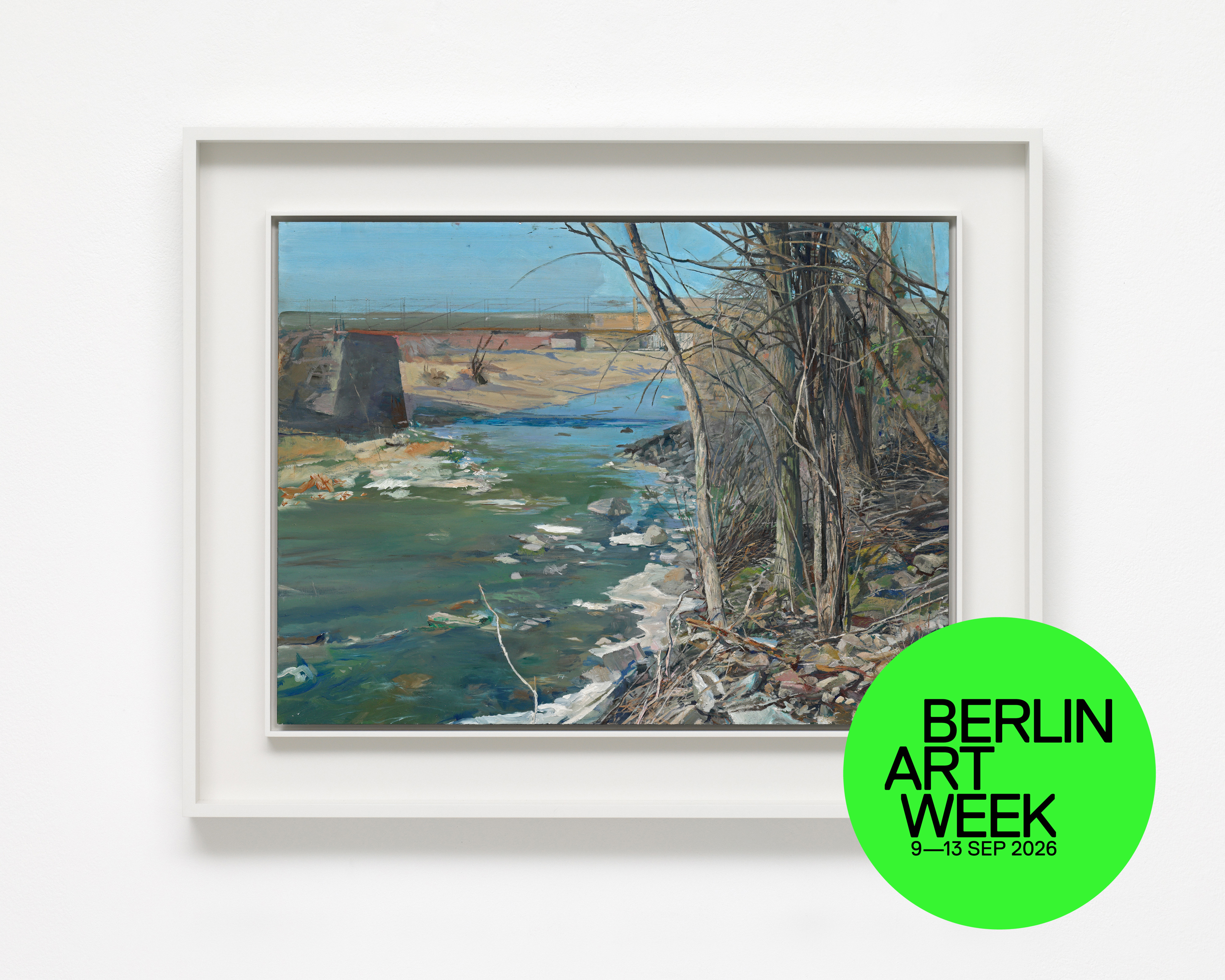
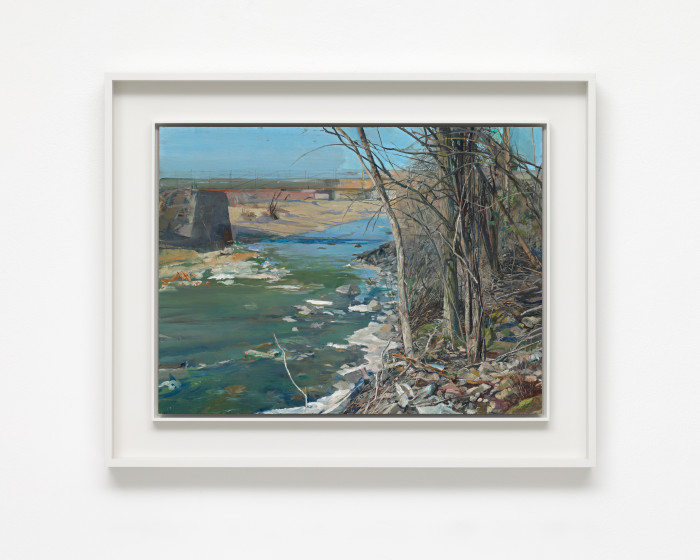
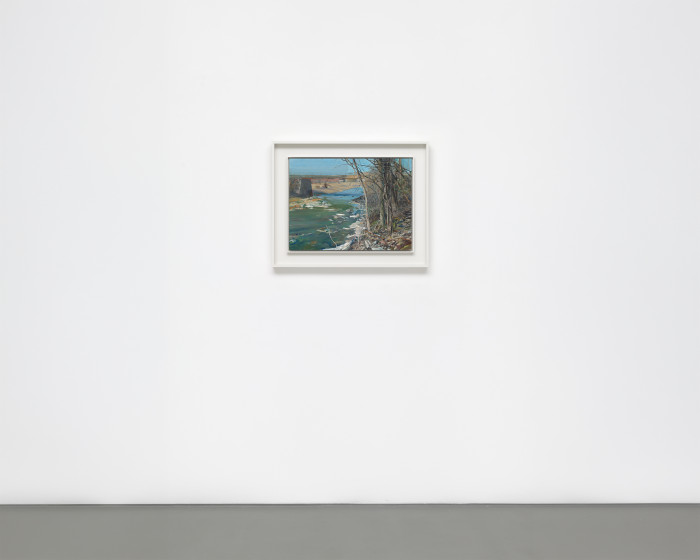
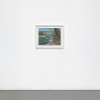
Late Ice, 2024
18 x 24 in
Jim Butler The New England Paintings / part of Gallery Night
Buchmann Galerie is pleased to present an exhibition of works by Jim Butler as part of Berlin Art Week 2026.
The exhibition brings together more than a dozen small-scale, intimate paintings that Jim Butler has created the past five years in the northern New England region of the United States. They are deeply considered pictures, evoking complex emotions through a focused sense of place unique in clarity and distinct realism.
The process of plein-air painting is central to Butler’s practice and critical to the viewer’s experience of the work. Each painting is made believable through nuances of light and air that define how things feel to the touch. Importantly Butler, who grew up in this region, links his immersive perceptual encounters simultaneously with an interior world of association and memory. The results are paintings that chronicle not only his life, but also touch universally felt aspects of our larger common psyche’s need to feel part of continuums of time, nature, and relationships.
The artist’s landscape images of trees, rivers, and boats are undeniably beautiful. Full of light and subtle textures, they cast a quiet spell allowing us to experience a world in delicate balance. Fascinatingly they are also remarkable for what they are not: here there is no drama or pressing narrative; no industrially altered landscapes, idealized rural vistas, or red sunsets. Rather, the subtleties of the world within a few kilometers of his house speak to him.
Thus, Butler depicts summer in the painting June with a high, even sunlight; and makes the early spring of Two Cherries tentative in the ways we all wish would last a bit longer. Broken splotches of light and shade in autumn fragment like pieces of russet colored mosaic as in September Morning. People and animals, if they appear at all, are present as only shadows. And then, like a puzzle coming together, the topography of this landscape emerges in the exhibition as one moves through it, forming a coherent whole of the places the artist has visited. In this way, the works gain their particular specificity: a contemporary world of human-scale, confirming our relevance as sensitive creatures willing to be vulnerable to the wonders around us.
This is why each picture is imbued with it’s own distinct sense of temporality. In the work Late Ice, for example, several different times overlap—from the active biology of a naturally evolving riverbank rendered in meticulous detail, to a century-old bridgehead, and then to a distant barn only faintly suggested. All energized by a river of cold water flowing through like an artery as constant as a clock. It is a painting of time that layers like geologic sediment.
Butler might return to the same spot with the same painting over multiple years in order to capture the short time of a blooming tree. For him it is a creative process that sometimes triggers many unplanned possibilities and he talks about painting outdoors as a waking dream. In working on a picture, for example, his thoughts are unavoidably centered on decisions about what is in front of him, yet might as easily slip into recollections of a painting he made in Providence, Rhode Island in the 1970’s. People, places, and conversations overlap. He describes the outdoor painting experience as like putting your finger in a continuous stream waiting to be tapped.
Thus, the question of emotion lies at the heart why these paintings compel us. Perhaps nothing signifies it more than his choice of painting boats. In the picture Muddy Inlet, for example, a small sailboat at dusk floats in water painted a gorgeous deep-green. The painting magically makes us aware of water’s mutability, which we obviously see creating buoyancy under the vessel, but then subliminally sense it above, filling our lungs with the soup of summer humidity. It’s a place we all know (or want to know) because its emotive content is universal, yet also remains specific to each viewer’s unique associations. Butler acknowledges this by revealing he too had such sensations when painting it. In fact, this was the first time he had painted a boat and was initially drawn to the color and patterns of the reflections underneath it. But while painting with the light failing as the sun set, it suddenly hit him that his uncle, an American scene painter in the 1930’s (who introduced him to oil paint), also painted boats along the coast a century before.
In this and many other ways, the pictures offer us a chance to connect with the world both within and outside ourselves. We are allowed to leave our immediate world and indulge our own reverie through a world that beautifully balances what we see with what we wonder.
Jim Butler
Born 1956 in Boston.
Lives and works in Brooklyn, NY and Shoreham, VT.
| 1980 | M.F.A. Indiana University, Bloomington |
| 1979 | Skowhegan School of Painting and Sculpture |
| 1978 | B.F.A. Rhode Island School of Design |
| 1977 | Yale Norfolk Summer School of Painting and Music |
| 2019 | Corning Museum of Glass Visiting Artist Residency |
| 2011 | Glass Factory Museum Residency, Boda, Sweden |
| 2007 | Rockefeller Grant, UrbanGlass, New York |
| 2006 | Hauberg Research Fellowship, Pilchuck Glass School |
| 2003 | Mellon Foundation Grant for New Sculpture in Glass |
| 1998 | Tiffany Foundation Nominee |
|
1987 1984 1983 |
Vermont Council on the Arts Grant to Individual Artists: Painting |
| 1979 | Ford Foundation Grant-Skowhegan School |