
Bernd Koberling
Painting
Bernd Koberling
Painting
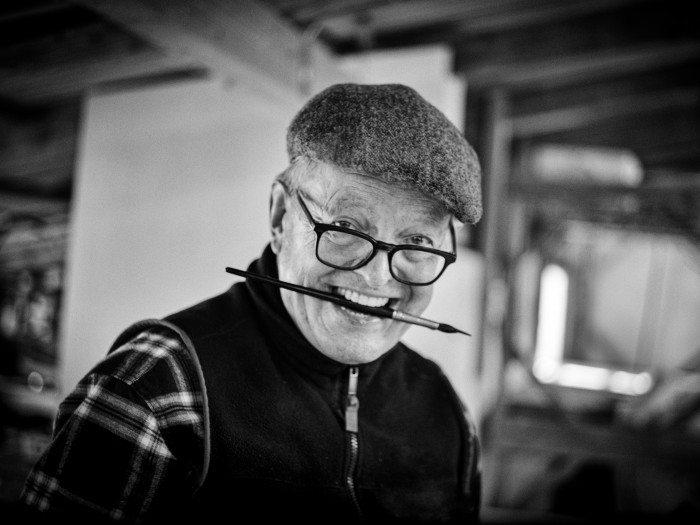
"I experience the greatest clarity and the deepest feelings of happiness when I am immersed in nature." This statement exemplifies the fundamental artistic stance of Bernd Koberling. Landscape has been his life's theme, which the artist has explored in color and form for over 60 years.
Growing up during World War II, Bernd Koberling experienced the bombing of Berlin. In the rubble of the ruined city, as he later recalled, "lilies and other plants bloomed." Even then, the young man's gaze focused on the resilient nature that sought its place even against the resistance of destruction.
At 19, after an apprenticeship as a cook, Bernd Koberling decided to become an artist. These were the years of social and political upheaval and transformation in the Federal Republic of Germany, a time when art increasingly demanded political relevance. Bernd Koberling studied at the University of Fine Arts in Berlin.
As early as 1960, he founded, together with painter K.H. Hödicke among others, the artist group "Vision," which turned against the dominance of abstract art with figurative, expressive painting, thereby opening the way for the following generation of the "Neue Wilde" (New Wild Ones) in the 1980s, including Helmut Middendorf, Salomé, and Rainer Fetting. In his painting, Koberling always moved in the tension between figuration and abstraction with the goal of "recreating an image from experiential power and what has been seen." The artists of these years turned against both the informal art of the pre-war period and purely figurative art. Bernd Koberling looked to American models such as William de Kooning, Arshile Gorky, and Helen Frankenthaler.
And while most German artists sought their creative environment in large cities like Berlin, Cologne, and Düsseldorf, Bernd Koberling was drawn to nature. His first and most important destination became Iceland. Since 1977, he has spent time every year on the island, whose nature fundamentally shapes his painting. He uses the motifs of the Nordic landscape of volcanoes, geysers, fjords, and glaciers to express "life."
Bernd Koberling developed his own style: Intense coloration, broad gestural actions, and consistent abstraction inscribe themselves as his own signature in art history. "The more intimate the image, the cruder the means," says Koberling.
Technically, too, Bernd Koberling repeatedly pursues his own experimental paths. In an early working phase, he stretched painted nettle fabric panels one over another to give paintings spatial depth and atmospheric density. He particularly revitalized the technique of watercolor painting. His intensive watercolors comprise large bodies of work and show the artist's mystical romantic side.
But again and again, Bernd Koberling also returns to oil and acrylic painting on very different painting grounds such as canvas, wood, or aluminum. Works with titles such as "Tides," "Water Lights," or "River Angels" show that nature for Koberling is the symbol of human existence. His idiosyncratic works lend the oeuvre a singular credibility that allowed him to stand out from the crowd of participants in such significant international exhibitions as "A New Spirit in Painting" in London and "Zeitgeist" in Berlin.
The artist's works are represented in numerous public and private collections, including the Bavarian State Painting Collections, the Deutsche Bank Art Collection, FRAC Nord-Pas-de-Calais, Dunkerque, France, Hamburger Bahnhof – Museum für Gegenwart, Berlin, Museum Ludwig, Cologne, Museum Würth, Künzelsau, Munich Re Art Collection, Nasjonalmuseet, Oslo, Norway, Nordiska Akvarellmuseet, Skärhamn, Sweden, the Ulla and Heiner Pietzsch Collection, Berlin, the Art Collection of the German Bundestag, Sprengel Museum, Hanover, Städel Museum, Frankfurt am Main, Reykjavik Art Museum, and the Vancouver Art Gallery, Vancouver.
Further insights into the artist's work can be found in the publication accompanying the exhibition "Bernd Koberling Works 1963-2017" at the MKM Museum Küppersmühle, Duisburg.